โครงการวิจัย ประจำปีงบประมาณ 2568
ชื่อโครงการ (ภาษาไทย)
การถ่ายทอดนวัตกรรมระบบบริหารจัดการฟาร์มอัจฉริยะ (AI FARM) เพื่อยกระดับรายได้ครัวเรือนของผู้เลี้ยงโคขุนตลอดห่วงโซ่อุปทาน
ชื่อโครงการ (ภาษาอังกฤษ)
Innovation Transfer of Smart Farm Management System (AI FARM) to Elevate Household Income of Beef Cattle Farmers Throughout the Supply Chain
บทสรุปผู้บริหาร
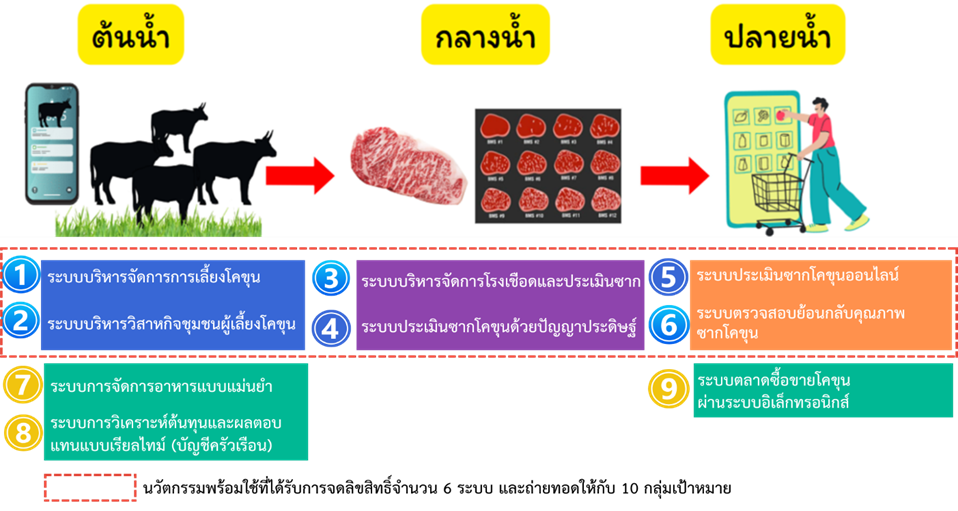
โครงการวิจัยนี้มีวัตถุประสงค์เพื่อปรับและถ่ายทอดนวัตกรรมระบบบริหารจัดการฟาร์มอัจฉริยะ (AI FARM) ซึ่งเป็นเทคโนโลยีพร้อมใช้ระดับ TRL 7 ให้เหมาะสมกับกลุ่มเป้าหมาย คือ ผู้เลี้ยงโคขุนต้นน้ำ และสร้างนวัตกรชุมชนผู้เลี้ยงโคขุนต้นน้ำโดยใช้นวัตกรรมระบบบริหารจัดการฟาร์มอัจฉริยะ (AI FARM) เพื่อยกระดับรายได้ครัวเรือนของเกษตรกรผู้เลี้ยงโคขุนต้นน้ำกลุ่มเป้าหมาย 100 ครัวเรือน จาก 6 กลุ่มวิสาหกิจ ในจังหวัดนครราชสีมาและจังหวัดอุดรธานี นวัตกรรมระบบบริหารจัดการฟาร์มอัจฉริยะ (AI FARM) ซึ่งระบบครอบคลุมการเลี้ยงโคขุนตลอดห่วงโซ่อุปทาน ตั้งแต่ต้นน้ำ กลางน้ำ ถึงปลายน้ำ ประกอบด้วย 6 ระบบ คือ 1) ระบบบริหารจัดการการเลี้ยงโคขุน 2) ระบบบริหารจัดการวิสาหกิจชุมชนผู้เลี้ยงโคขุน 3) ระบบบริหารจัดการโรงเชือดและประเมินซาก 4) ระบบประเมินซากโคขุนด้วยปัญญาประดิษฐ์ 5) ระบบประมูลซากโคขุนออนไลน์ 6) ระบบตรวจสอบย้อนกลับคุณภาพซากโคขุน ซึ่งจากการลงพื้นที่เก็บรวบรวมข้อมูลของคณะวิจัย พบว่า ปัจจุบันเกษตรกรประสบปัญหาราคาขายโคตกต่ำ โดยเฉพาะโคสายพันธุ์พื้นเมือง โคไล่ทุ่ง ซึ่งไม่ได้มีการควบคุมคุณภาพการเลี้ยงและเนื้อไม่ได้คุณภาพตามที่ตลาดบนต้องการ และถูกเนื้อวัวต่างประเทศราคาถูกโจมตีตลาดซื้อขายเนื้อวัว ทำให้เกษตรกรผู้เลี้ยงโคขุนขาดทุนและยกเลิกการเลี้ยงเป็นจำนวนมาก ในขณะที่ปศุสัตว์จังหวัดนครราชสีมาและอุดรธานี ได้ให้การสนับสนุนน้ำเชื้อสายพันธุ์วากิว เพื่อให้เกษตรกรนำไปผสมกับโคพื้นเมืองเพื่อให้ได้เนื้อที่มีคุณภาพ และเป็นที่ต้องการของตลาด ดังนั้น เกษตรกรหลายรายสนใจที่จะปรับเปลี่ยนการเลี้ยงจากโคสายพันธุ์พื้นเมือง เป็นโคสายพันธุ์ผสมวากิวเพื่อเพิ่มมูลค่า โดยเฉพาะการเลี้ยงโคขุนต้นน้ำ ซึ่งใช้ระยะเวลาเลี้ยงประมาณ 1 ปี โดยมีวิสาหกิจและฟาร์มที่ต้องการซื้อโคต้นน้ำไปขุนต่อ โดยมีการทำสัญญารับซื้อ ซึ่งการคัดเลือกสายพันธุ์ น้ำเชื้อที่มีคุณภาพ ที่เป็นที่ต้องการของตลาด เช่น วากิว จะทำให้เนื้อวัวมีคุณภาพสูง และขายได้ราคา นอกจากนี้ ระยะเวลาการเลี้ยง 1 ปี เกษตรกรจำเป็นต้องเก็บรวบรวมข้อมูลด้านต้นทุนอาหาร ส่วนผสมอาหารที่มีเปอร์เซ็นต์โปรตีนที่เหมาะสมทำให้ได้น้ำหนักตัวของวัวที่มากขึ้น ทำให้เกษตรกรสามารถได้รายได้ที่สูงขึ้น

ดังนั้น คณะผู้วิจัยซึ่งได้พัฒนานวัตกรรมการบริหารจัดการฟาร์มอัจฉริยะ (AI FARM) ซึ่งมีระดับ TRL 7 จึงได้นำปัญหานี้มาทำการแก้ไขโดยการพัฒนาต่อยอดนวัตกรรมและปรับใช้เทคโนโลยีให้เหมาะสมกับกลุ่มเป้าหมายผู้เลี้ยงโคขุนต้นน้ำ โดยทำการพัฒนาเพิ่มอีก 3 ระบบ คือ 1) ระบบการจัดการอาหารแบบแม่นยำ 2) ระบบการวิเคราะห์ต้นทุนและผลตอบแทนแบบเรียลไทม์ (บัญชีครัวเรือน) 3) ระบบตลาดซื้อขายโคขุนผ่านระบบอิเล็กทรอนิกส์ (E-marketplace) โดยนวัตกรรมที่พัฒนาต่อยอดนี้ ครอบคลุมการเลี้ยงโคขุนในทุกช่วงของห่วงโซ่อุปทาน ได้แก่ ต้นน้ำ (การคัดเลือกสายพันธุ์, การผสมเทียม และการบันทึกประวัติสุขภาพโคขุน, การให้อาหาร, ระบบการจัดการอาหารแบบแม่นยำ, ระบบการวิเคราะห์ต้นทุนและผลตอบแทนแบบเรียลไทม์ (บัญชีครัวเรือน), กลางน้ำ (โรงเชือด, การวิเคราะห์คุณภาพซากโคขุน, ใบประเมินราคาซาก), และปลายน้ำ (การประมูลซากออนไลน์, ระบบตลาดซื้อขายโคขุนผ่านระบบอิเล็กทรอนิกส์ (E-marketplace), การตรวจสอบย้อนกลับคุณภาพซากโคขุน) การจัดการแบบขับเคลื่อนด้วยข้อมูลนี้ช่วยเพิ่มคุณภาพการเลี้ยงโคขุน ส่งผลต่อการจัดเกรดซากที่ดีขึ้นและมูลค่าเนื้อที่สูงขึ้น ระบบยังรองรับการตรวจสอบย้อนกลับของเนื้อโคขุน ซึ่งจะช่วยเพิ่มขีดความสามารถในการแข่งขันระดับนานาชาติ ใช้ระเบียบวิธีวิจัยแบบมีส่วนร่วม (Participatory Action Research: PAR) โดยร่วมมือกับหน่วยงานต่าง ๆ ได้แก่ สถาบันหลัก มหาวิทยาลัยราชภัฏนครราชสีมา สถาบันสนับสนุน สถาบันการศึกษาในภูมิภาค (มหาวิทยาลัยราชภัฏอุดรธานี) หน่วยงานภาครัฐ (องค์การบริหารส่วนตำบล สำนักงานปศุสัตว์อำเภอและจังหวัด นักวิชาการเกษตร) เกษตรกร ผู้ประกอบการ และกลุ่มวิสาหกิจโคขุนในพื้นที่เป้าหมาย กิจกรรมหลักของโครงการ กระบวนการดำเนินงานประกอบด้วย 4 กิจกรรมสำคัญ ได้แก่ 1) ปรับเทคโนโลยีให้มีความเหมาะสมกับกลุ่มเป้าหมาย โดยเฉพาะกลุ่มผู้เลี้ยงโคขุนต้นน้ำ 2) การถ่ายทอดองค์ความรู้และนวัตกรรม จุดประกายความคิดและสร้างกระบวนการเรียนรู้เพื่อพัฒนานวัตกรชุมชนอย่างน้อย 100 คน จาก 6 กลุ่มเป้าหมาย ให้มีความเข้าใจเกี่ยวกับระบบบริหารจัดการฟาร์มอัจฉริยะ และสามารถเป็นผู้นำการเปลี่ยนแปลง 3) การพัฒนาระบบพี่เลี้ยง (นวัตกรผู้เลี้ยงโคขุนต้นแบบ) โดยจัดตั้งระบบสนับสนุนทางเทคนิคและให้กำลังใจทั้งในรูปแบบออนไลน์และลงพื้นที่ เพื่อช่วยให้เกษตรกรสามารถปรับใช้และรักษานวัตกรรมไว้ได้ 4) การสร้างเครือข่ายความร่วมมือ ประสานงานกับหน่วยงานภาครัฐท้องถิ่นในการขยายการใช้นวัตกรรม นำไปสู่การจัดตั้งศูนย์เรียนรู้การเกษตรอัจฉริยะเพื่อการเลี้ยงโคขุนจำนวน 6 แห่งในพื้นที่เป้าหมาย การแลกเปลี่ยนเรียนรู้ สร้างพื้นที่ให้ชุมชนที่ได้นำไปใช้จริงสามารถแลกเปลี่ยนประสบการณ์กับผู้พัฒนา ส่งเสริมการใช้งานอย่างต่อเนื่องและขยายผลการใช้นวัตกรรม ประโยชน์ที่คาดว่าจะได้รับ โดยโครงการจะขับเคลื่อนและสร้างนวัตกรชุมชนในกลุ่มเกษตรกรผู้เลี้ยงโคขุนที่ใช้นวัตกรรมระบบบริหารจัดการฟาร์มอัจฉริยะ (AI FARM) เพื่อเพิ่มประสิทธิภาพในการเลี้ยงโคขุนต้นน้ำ โดยเฉพาะการควบคุมเรื่องของต้นทุนอาหาร ควบคุมคุณภาพของการเลี้ยง เพื่อให้สามารถขายได้ราคาตามที่ผู้ซื้อต้องการ ทำให้รายได้ต่อครัวเรือนเพิ่มขึ้น เสริมสร้างขีดความสามารถในการแข่งขันของผู้ประกอบการโคขุน เสริมสร้างเศรษฐกิจฐานรากให้เข้มแข็ง ยกระดับมาตรฐานการเลี้ยงโคขุนให้ได้คุณภาพระดับสากล
This research project aims to adapt and transfer the Smart Farm Management System Innovation (AI FARM) — a ready-to-use technology at Technology Readiness Level (TRL) 7 — to suit the needs of upstream beef cattle farmers, and to develop community innovators among these farmers through the use of AI FARM. The goal is to increase household income for 100 target farming households from six community enterprise groups located in Nakhon Ratchasima and Udon Thani provinces.

The AI FARM innovation covers the entire beef cattle production supply chain — upstream, midstream, and downstream — through six integrated subsystems:
1) Beef Cattle Farm Management System
2) Community Enterprise Management System for Beef Cattle Farmers
3) Slaughterhouse and Carcass Evaluation Management System
4) Artificial Intelligence-Based Carcass Evaluation System
5) Online Beef Carcass Auction System
6) Beef Carcass Quality Traceability System
Problem Context
Field data collection revealed that farmers currently face low cattle market prices, particularly for native and free-grazing cattle, which lack controlled quality and fail to meet premium market standards. Additionally, cheap imported beef has heavily disrupted the domestic market, leading many farmers to suffer losses and abandon cattle farming. Meanwhile, the Provincial Livestock Offices of Nakhon Ratchasima and Udon Thani have supported Wagyu semen distribution, enabling farmers to crossbreed native cattle with Wagyu to produce higher-quality beef that meets market demand. Many farmers are therefore interested in shifting from native breeds to Wagyu-crossbreeding to increase market value. Specifically, upstream fattening involves about one year of raising cattle, after which farms and enterprises purchase them for further fattening under contract farming arrangements. Selecting market-demanded high-quality semen (e.g., Wagyu) ensures better carcass quality and higher selling prices. During the one-year rearing period, farmers need to collect feed cost data and manage feed composition to maintain the appropriate protein percentage, which leads to improved weight gain and higher income.
Innovation Enhancement and Adaptation
To address these challenges, the research team — having developed AI FARM at TRL 7 — has enhanced the technology by adding three new subsystems tailored for upstream beef cattle farmers:
1) Precision Feed Management System
2) Real-Time Cost and Return Analysis System (Household Accounting)
3) E-Marketplace System for Electronic Beef Cattle Trading
Together, these innovations now cover the entire beef cattle value chain:
- Upstream: Breed selection, artificial insemination, cattle health recordkeeping, feeding, precision feed management, and real-time cost–return analysis
- Midstream: Slaughterhouses, carcass quality analysis, and carcass price evaluation
- Downstream: Online carcass auctions, electronic cattle trading (E-marketplace), and beef carcass quality traceability
This data-driven management approach improves beef cattle quality, resulting in higher carcass grades and increased market value, while enabling full traceability to enhance international competitiveness.
Research Methodology
The project employs Participatory Action Research (PAR) in collaboration with multiple stakeholders, including:
- Main institution: Nakhon Ratchasima Rajabhat University
- Supporting institution: Udon Thani Rajabhat University
- Government agencies: Subdistrict Administrative Organizations, District and Provincial Livestock Offices, agricultural extension officers
- Farmers, entrepreneurs, and community beef cattle enterprises in the target areas
Key Project Activities
The implementation process consists of four main activities:
- Technology adaptation to fit upstream beef cattle farmers’ needs.
- Knowledge and innovation transfer to inspire and train at least 100 community innovators across six target groups, enabling them to understand and lead the adoption of smart farm management systems.
- Development of a mentorship system, identifying model community innovators (lead farmers) to provide technical support and motivation through both online and field-based activities, helping farmers apply and sustain the innovation.
- Network building and collaboration, coordinating with local government agencies to expand innovation adoption and establish six Smart Agriculture Learning Centers for Beef Cattle Farming in the target areas. These centers will facilitate experience sharing between communities and technology developers, ensuring sustainable use and wider dissemination.
Expected Benefits
The project will drive the creation of community innovators among upstream beef cattle farmers through the adoption of the AI FARM system, leading to:
- Improved farming efficiency, especially in feed cost control and quality assurance
- Higher household income through meeting buyer quality standards and obtaining better selling prices
- Enhanced competitiveness of beef cattle entrepreneurs
- Strengthened grassroots economies
- Upgrading beef cattle farming standards to meet international quality levels